Blog # 120…August 2021

Moore and Parker

Boxing came into my life unexpectedly in 1956 when I was a waitress at a summer hotel in Muskoka. The brother of the owner was a fight referee in New York and suggested the site as a training camp for James J Parker, a Canadian heavyweight who was challenging Archie Moore for the World title in Toronto in July. So I was serving meals to the fighter, his manager, trainer, sparring partners and an assortment of other Runyonesque characters associated with the game...I gave Rocky Marciano lunch one day, quite an experience for a 19 year old physiotherapy student!


I’ve maintained a marginal interest in the sport until recently when I started to notice a considerable following in an unexpected  group -  young women - and not just observing but getting serious and stepping into the ring. I felt intuitively that women seem ill-equipped to box, not just physically but emotionally, and decided to delve a bit deeper.

 I started with Joyce Carol Oates’  1993 book On Boxing to try and get a sense of why the sport, with its inherent violence would appeal to anyone, not only women. If you know her work at all, which I didn’t, she‘s an extremely thorough, prolific  and thoughtful writer of both fiction and non – and I thought if anyone could discover and tell me why boxing fascinates, it would be JCO.  She explored the sport from many angles and pondered its ambiguities, paradoxes and curiousities: boxers are often kind, gentle, well mannered people who become murderous brutes when they enter the ring; men usually identify with the winner, women with the loser; it’s the most primitive, yet most sophisticated of sports; its savagery is contained by a myriad of rules and regulations; it provides an outlet for poor, disenfranchised youth, holding out the promise of another life.  And on and on she goes, sometimes rhapsodizing and making comparisons to Greek and Shakespearean tragedies, still no clear idea of why so many of us find it fascinating.

Eastwood and Swank

Million Dollar Baby swept the Oscars in 2004, Hilary Swank playing a young girl determined to be a boxer , her coach played by Clint Eastwood. She had a promising career…until, well she didn’t.  Totally worth worth watching again so I won't spoil it.


US Olympian and Deming
And that brings us back to women in the sport and Sarah Deming’s 2019 YA book Gravity. Sarah brings her Jewishness and her experience as a NYC Golden gloves champion and as a boxing journalist covering the 2016 Rio Olympics into the novel. We get a chance to be backstage with Gravity Delgado in her life at home, in the gym, the ring and in her love life. Many of the contradictions that JCO mentions are here…before every fight, Gravity says the Shema, a Jewish prayer to keep her opponent, the audience and those she loves safe - she includes all of the people of Brazil before competing in her Olympic fight.

So we're left without the answers to many of our questions about why boxing holds such appeal mixed with revulsion for so many of us, some things are obvious, others more perplexing...a bit like life.

August already, half of summer gone. half left, enjoy the rest, see you in September. 


Blog # 119…July 2021


Craig

This year's PRIDE, virtual for the second year,  reminded me of being taken on a date (remember those?) in the early 70's to see Craig Russell at a hotel out near the airport. We were fascinated to see Craig appear convincingly and in quick succession as Judy Garland, Carol Channing, Marlene Dietrich, Barbra Streisand and Peggy Lee. In the language of the day, he was called a female impersonator and viewed as something titillating.  Now, a few decades later, we relish PRIDE, and RuPaul’s Drag Race is pretty mainstream watching for all ages.

Who doesn’t love the art of deception sometimes…dressing up and taking on another identity? Or disappearing completely - tempting in these times of perpetual display, the magic of invisible ink, or black light theatre…being a fly on the wall.


Enza
Back in the day when we used to go out and mix with people in the streets (remember that?) one of my favourite things was going down to Church Street on Halloween with my friend Frank, swaggering around in a sharp suit, dark shirt, pale necktie and fedora, five o’clock shadow achieved with Vaseline and pepper - a dead ringer for Al Capone.  I loved kibitzing with the drag queens, toying with my idea of the tough guy stereotype while they flirted coyly in a parody of Mae West. I have a great photo, buried somewhere, with Enza Anderson, transgender rights activist who ran for mayor of Toronto in 2000.


Kyne

These memories prompted me to think about a blog, and then I heard an interview with Kyne Santos, the Filipino/Canadian drag queen who appears on TikTok.  She’s a self-confessed math nerd and, under all the fabulous costumes and makeup she encourages people to see math as approachable as well as important. She also uses the platform to confront racism and let young queer people know that “It gets better”.


Natalie

We have Baltimore to thank for many things…crab cakes, the Orioles in Camden Yards, David Simon’s The Wire, John Waters and Divine and a host of drag queens.  Natalie Wynn’s YouTube
channel Contrapoints explores politics, gender, ethics, race and philosophy, providing reflective arguments to right wing political positions. Taking the form of debates between opposing parties, Natalie plays all the parts herself and was called “the Oscar Wilde of YouTube” for fighting the alt right with decadence and seduction.


We’ve come a distance in our recognition and (sometimes reluctant) acceptance of variation, whether it’s race, gender or any of the other ways we differ from each other...we don't all fit into the same package. The bar has shifted on what gets said and shown and how, thanks in large part to these courageous artists.

As I'm writing this though on the eve of Canada Day, we've been shattered by the murder of four members of a Muslim family in London and the discovery of hundreds of unmarked graves of children at residential schools in British Columbia and Saskatchewan. It's shaken our sense of who we are and what progress we've made. I'm struggling with that, maybe you are too?  I'm posting this with the thought that we need to ask ourselves - where do we go from here? 

This year Canada Day is different, a time for reflection rather than celebration. But, lets reflect on what we've done that's good and try and do better - for 9 year old Fayez Afzaal, an orphan with his life ahead of him, and for the thousands of living souls affected by the horrors of residential schools.

This country with all its defects and offenses is still a good place to live, lets make it that way for everyone.


 Blog # 118.1...June 2021

I know you've already heard from me this month, and I usually write about how art surrounds and informs us, but this morning I felt moved to say something else. 

The week has been full of the horror of the murders so close to home - in London. Despite all the coverage, I felt I wanted to know something about the family beyond that they were Muslim. In yesterday's Globe and Mail, I read a few details about their personal lives and discovered that Salman, the father, was a physiotherapist. When I reached out to Sharon Switzer-McIntyre at U of T, I discovered that he was a graduate of their Bridging Program. Sharon was the founder of this program, set up to enable internationally trained PT's to meet the qualifications to practice in Canada. Last Fall I wrote a piece about the Program, including profiles of two recent graduates, from Brazil and India, that's posted on Medium.com. 

We all feel sad and diminished by these deaths, but somehow the pain is deeper now that I feel a kinship with Salman through our shared profession.  A lot of talk this week has circled around how to combat Islamophobia. It's complicated I know, but more personal details about the individuals in this family (and future victims of racially based violence, because there will be some) rather than focusing on their faith will go a long way towards making us feel closer to them, sharing their humanity. We may need to seek out the information and it will be a painful process for us but we owe it to the victims, the country and ourselves.


Blog # 118…June 2021

Poets Laureate aren’t anything new – Geoffrey Chaucer was paid 10 shillings a year in the 1300’s to write for King Henry 1 and there’s been an unbroken line (of males with Carol Ann Duffy, 2009-19, the one exception) in Britain ever since.  Canada climbed onboard with Dennis Lee (2001-04) taking on the role in Toronto and George Bowering appointed (2002-04 ) at the federal level - called Parliamentary Poet Laureate. We’ve done a bit better in the gender balance with 3 women Parliamentary PL’s since.   


Louise Halfe, the current poet in parliament, checks many boxes - she’s a Cree elder (at 68) from northern Alberta, a professional social worker with a special certificate in drug and alcohol counselling. Taken from her parents at the age of 7 to the Blue Quill residential school where she spent 10 years, she brings the experience as a survivor of that system as well as an indigenous feminist perspective to her poetry. Louise tells the stories of women who came before her, the kinship relations between women and their importance in Cree culture.   She incorporates white space into her poems to emphasize the isolation and loss felt by her people. She also uses code switching - I know, I had to look it up - telling a complete tale by weaving the Cree language and teaching into her poems as a reminder of the devastation of losing language and the fragmentation of history, culture and land that can’t be conveyed in English.                                                                                                 

In Toronto since Dennis, the past 2 decades have seen a range of poets, including Dionne Brand (2009-12), Anne Michaels (2016-19) and today, Al Moritz.  George Elliot Clarke (2012-15) with his typical exuberance, followed the Toronto gig with a hop scotch into the Parliamentary position (2016-18).

All the provinces and 2 territories honour poets laureate and in fact two areas led the field, with Yukon appointing their first in 1994, New Westminster in 1997 and Cobourg in 1998. Some have appointed them for life, in Cape Breton, Rita Joe is the lifetime poet laureate of the Mi’k maq people. Ottawa has both French and English. I don’t know about you but I had no idea there was such a substantial poetry subculture lurking just below the surface, toiling in the fields, working from the bottom up, so to speak,... Poets link us to our environment and to traditional knowledge, serving as ambassadors of language and culture. It’s good to see them being recognized.


Now, Ontario boasts Randall Adjei, a spoken word artist as its first poet laureate.   Although not yet thirty, he  brings years of personal experience and community organizing and is the founder of RISE - Reaching Intelligent Souls Everywhere. A self confessed bad boy (he was arrested at 12) Randall has turned his life around and is committed to helping other young people do the same - providing a safe and inclusive space for expression, connecting and developing a more positive sense of themselves.  This newest position was created in memory of Gord  Downey of the Tragically Hip and it's particularly moving that the first recipient shares Gord's love of the lyric word and a passion for drawing attention to stories of injustice.   

Randall and Louise couldn’t be more different at first glance, but their commitment to bringing their backgrounds and experiences into the light through their work is the same. Code switching, rapping, using not only words but language forms, music and visuals serve to attract and inform us. Listening to the voices of poets  helps connect us to the world we share, and to appeciate and make some sense of it and of each other. There's a poet somewhere out there who will speak directly to you and steal your heart, break it, make it sing, maybe both...keep your eyes and ears open to welcome them in.                                               .
                                                            

Finally, huge congratulations to Michelle Good, Louise's fellow Cree from western Canada, a lawyer, also in her 60's, who just won the Amazon Canada first novel award for Five little Indians. It's on the short list for the Governor General's award for fiction. And poet and Rhodes scholar Billy-Ray Belcourt's memoir A History of My Brief Body, about growing up indigenous and queer is up for non fiction. Results  announced on Tuesday, June 1...fingers crossed!

See you next on Canada Day.


Blog # 117…May 2021

Early in 2020, around the time rumours of the corona virus started creeping into our consciousness, I was on a Toronto street car and saw a couple of people move away from an Asian woman, one even pulling her coat collar up over her mouth and nose -  I’m sure the woman noticed too.  It was the first of many such incidents, some much more direct and hurtful. And tragically, six Asian women were targeted and murdered in Atlanta by a white man earlier this year. The pandemic did originate in Wuhan, China, drastically affecting their population before moving on to us. Systemic racism dates back a couple of centuries and has always lurked just below the surface; it’s now raised its ugly head and become part of a public discourse.

My friend Margaret,who was born in Seattle of Japanese parents, reports verbal abuse being hurled by young men passing her house in a car…not brave enough to confront a tiny, solitary 90 year old woman in person!   She describes this and her family’s experience being interned during WWll in her wonderful video An Extraordinary Gift. Take a look and see what bravery looks like:      https://www.youtube.com/watch?list=TLGGExz5mH4vjZwxMTAyMjAyMQ&v=FxikA8Akk7E&feature=emb_title


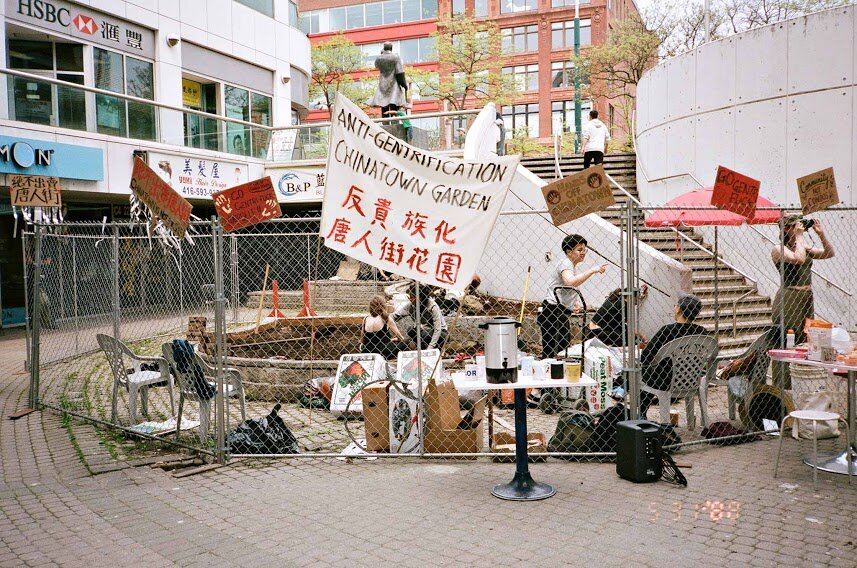
Toronto’s Chinatown was one of the first neighbourhoods to feel the impact of SARS in 2003, and then, of COVID 19 in 2020. A decline in business and an increase in harassment was noticed as early as January 2020. So, on top of sharing the anxiety we all feel over the pandemic, the threat of violence looms over many Asian-Canadians.

Asian artists have stepped forward to confront the situation with political expression, forming Tea Base, an arts collective to explore experiences of anti-Asian racism as well as the joy of community. Three Toronto artists with connections to Chinatown use their art to explore aspects of their identity, being perceived as foreign although they may be, feel and identify as Canadian.


The Anti-Displacement Garden created an intergenerational neighbourhood hub in the lower courtyard of the Chinatown Centre mall, replacing a pile of bricks with zucchini, corn, broccoli, lemongrass, bok choy, mint and an array of herbs. Tea Base, located inside the mall, is co-directed by conceptual artist Florence Yee (a third generation Canadian) who documented the lush garden last summer and had the images printed on white cotton. Yee says ”The garden is an example of how taking care of a space creates some connections between us, the neighbouring businesses and the people that come by.”

Photographer Morris Lum has travelled across North America recording the unique architecture and community institutions in cities with a significant Chinatown - restaurants, mom and pop stores and cultural hubs that may be invisible to passersby. His goal is to document how gentrification, economic challenges and settlement trends of more recent Chinese immigrants are affecting the look and feel of these neighbourhoods.  Lum, who was born inTrinidad and grew up in Mississauga, uses his lens to focus on these community institutions before they disappear, providing an appreciation for how these unique but similar Chinatowns made it easier for future generations to move to North America.

Christie Jia Wen Carriere, the other director of Tea Base, is a painter and illustrator who uses her art to explore her Chinese-Canadian identity, the long history of sexualizing Asian women and cultural appropriation. In her more recent work, The Chinatown Mall Project she’s finding ways to showcase joy within the Chinese community and Chinatown. A series of vibrant paintings feature shopkeepers in the Mall surrounded by the special wares they sell – jade, traditional Chinese herbs or Hello-Kitty branded snacks. Pain and trauma are under the surface, but survival and joy  shine through.

Inspiration for this blog came from a piece sponsored by the Goethe Institute and featured in The Kensington Issue of the West End Phoenix.  WEP is a great indie newspaper, leaning to the west and the left, on issues that concern us all.  Check it out at   www.westendphoenix.com and read the whole piece - Political Expression…or better yet subscribe, you won’t regret it.                                                                         

I’m sending this on May 1, International Workers’ Day, I’ve already expressed my concerns about workers.  So, on a lighter note - since I've been able to walk around with my new hip, I've been delighted by the whimsy of the many fairy doors comceived and constructed by my neighbours. 

THANKS, whoever you are! 


And finally, if you have difficulty opening Margaret's  video with the link above, different operating systems respond differently. try:    https://www.youtube.com/watch?list=TLGGExz5mH4vjZwxMTAyMjAyMQ&v=FxikA8Akk7E&feature=emb_title   


Blog # 116…April 2021

I’m reading a lot more than usual  these days, time that used to be spent swimming, eating out, seeing friends, going to movies, well you know what I mean. So the past few blogs have been slanted towards the printed word, nothing wrong with that, but I’d like to get back to some other forms of creative activity.

Part of art’s job is to find beautiful ways into and sometimes through what's controversial or hard, maybe unbearable. Artists are responding to current issues in some brilliant ways…take a look below, at the huge mural mounted by students at U of T on the side of their building on Spadina, just north of College - each letter is composed of  student's drawings. The visibility of black accomplishments is also being supported by ads in the New Yorker featuring black-owned restaurants. It's happening all over!

Faculty of Architecture, Landscape and Design

Tim Okamura left Edmonton in the early 90's for NYC and had a bird's eye view of the pandemic from his apartment across from a major hospital. In March 2020, his cousin died of the virus on a cruise ship and Tim developed it himself, fostering a personal as well as professional interest that led to a new direction in his painting - centering on powerful scenes of front line workers at their jobs.

Global News

Alex Pangman


Jazz singer Alex Pangman began singing with 30% lung capacity due to cystic fibrosis and her voice and career began to soar after a double lung  transplant in 2008. Her experience led to an interest in other musicians who had overcome physical difficulties: from Django Reinheart who developed unique original guitar chords after a devastating hand injury in a fire, to our own Jeff Healey, visually impaired from birth, playing his guitar flat  across his lap…and of course, George Shearing and Stevie Wonder - and Beethoven.


I'm lingering on the thoughts about friendship that I put out last month - theyve become deeper and more personal as I've been in a position to need the support of friends, including the ones who happen to be in my family - dual citizens, so to speak.  Although I thought I was sneaking unnoticed into my mid eighties, it seems aging won't be ignored and I had a successful hip replacement since we last met, March 24th to be exact.  I'm almost as good as new, for now anyway. And my friends are the best!

See you next on May Day...many conditions of work are in a sorry state right now, changing, disappearing, causing terrible suffering in so many ways beyond economic - keeps me awake at nights!                                                                                                                                     


Blog # 115…March, 2021

Well, it’s almost a year since you-know-what leapt out of the darkness, changed the world and made us realize the importance of things like friendship.

I don’t need Aristotle to tell me that friendship is a major contributor to happiness. I learned that a long time ago, 1963 to be exact, when on a whim I decided to stop in Denmark and work for a while. The job I was offered was in Odense, a small city with no foreign population except the tourists who flocked to Hans Christian Andersen’s house. So I got a very authentic Danish experience, learning the language from scratch like a child, and with no guide to the customs – which are precise and many. I was forever doing the wrong thing with food, many other things too. The most important thing was, people were kind and hospitable but I had no friends.

That experience marked me forever, I’ve cherished and valued my friends ever since and this period has brought some of my notions about friendship and a deep appreciation for friends into focus. Although, or maybe because they're chosen and don’t have the background intimacy of family members, friends have some qualities that make them uniquely precious - particularly now. Some become closer due to the isolation, others recede, maybe temporarily, maybe permanently.  Random meetings at a bar or grocery store, occasional encounters when we may not even know their names, help anchor us and make us conscious of having a place in the world...but they're not happening.  And they can’t be replaced with a phone call or Zoom chat.  It becomes clear that not everything can be expected of everyone and some surprising connections emerge, that’s my experience anyway. I’ve had to become comfortable with asking friends for help and am touched by their responses and how they make it easier for me to ask.

My friend Heather keeps up on things neurophysiological and told me something recently that has profound implications for friendship. Gratitude and empathy, both essential ingredients of friendship, are mainly experienced in the prefrontal cortex, the executive centre of the brain. It's responsible for controlling the irrational emotions of the amygdala and can decrease stress. So science bears out what we feel instinctively.

Although I haven’t particularly searched them out, some books have come my way recently that explore friendships, those of women in particular.

 I discovered Rumaan Alam when he started a Tuesday book review column for lesser know authors in the New York Times as a complement to Friday’s heavy hitters. He left to publicize a book called That Kind of Mother, about a white woman adopting her black nanny’s child when the mother dies in childbirth. I found it remarkable and recently got a previous work called Rich and Pretty which I’ve just finished. It features two young girls who meet in primary school and become fast friends, and follows them into adulthood as they move apart, then back together. It’s an up close look at how interests and situations affect friendships and how they sometimes survive regardless - familiar terrain for many of us as we progress through life. By the way, Rumaan is a gay Bangladeshi/American man who somehow nails it writing about women.

Kiley Reid came to my attention on the Toronto Public Library’s Crowdcast reading series. She’s just brought out her first book, Such a Cute Age, about a young black nanny and her relationship with her white employer. There are elements of the complexities of race, relations between employers and employees, especially in an area as personal as child care, and friendship between women.  Kiley has played many roles in a variety of jobs, including being a nanny, before this book brought success.

Of course, I can’t write about women’s friendship without giving a nod to Elana Ferrante and her (or is it his?) Neapolitan Quartet. The friendship between Lina and Lenu (short for Elena) begins when they are very young in the slums of Naples, continues through adolescence into old age. It’s a tour de force with very specific reference to Italian culture, but with universal themes of love, competition, pain and loss.

And, since poems capture feelings so well, I’m dipping into Homie by Dazel Smith, who writes of friendship between young, gay, HIV positive men.  They (the preferred pronoun) explore friendship’s darkest corners, the terror of being known, saying  ”I’m sorry I have no happy poems" but calling friendship “that first and cleanest love”.

So, as advancing age inevitably comes with the death of friends, I guard fond memories of time spent together, feel lucky to have had them in my life, and cherish the ones who are still with me. And  my heart reaches out to young people missing physical contact with friends and celebrating important milestones together, we can catch up on things later, but they're missing them forever. 

See you in April, for showers, and hopefully vaccines for us all.